




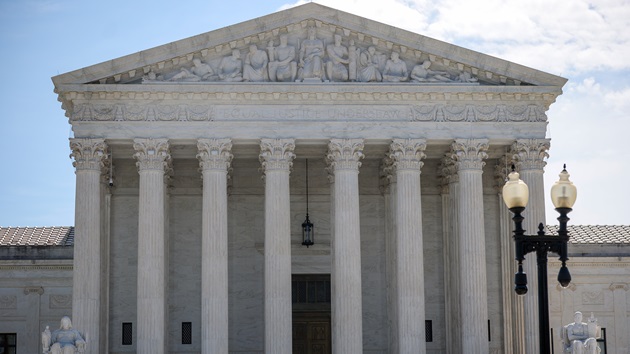
(WASHINGTON) -- The Supreme Court on Monday limited law enforcement's use of sprawling "geofence warrants" that track a suspect using cellphone location data from a broad swath of users, including people with no connection to a crime.
In a 6-3 decision, Justice Elena Kagan wrote that collection of location data through a geofence warrant implicates the Fourth Amendment's protections against unreasonable searches and seizures -- a setback for the federal government, which argued the warrants were a critical law enforcement tool that did not amount to a search at all.
"An individual has a reasonable expectation of privacy in records about his cell phone's location, and police intrude on that constitutionally protected interest when they demand the information -- even though for only a limited time, and from a third-party tech company," Kagan wrote for the majority.
Kagan concluded that location data -- which she described as "a personal journal of a user's movements" -- resembles other kinds of private materials such as emails, photographs or documents and should be "shielded from the 'inquisitive eyes' of the government."
"Today's decision follows from the same judicial obligation, to guard against the same risk of undue encroachment. The Fourth Amendment applies, too, when officials tap into Google's 'database of physical location information.' That database is new, but the principle covering it is not: That principle is instead the one our history has given. The Fourth Amendment must, as ever, protect against unjustified governmental intrusion on the privacy of the individual," Kagan wrote.
In effect, the ruling requires authorities to obtain a narrowly tailored warrant before examining cellphone data of a broad swath of users in an area.
While the Supreme Court ruled that location data is protected by the Fourth Amendment, the justices did not weigh in on the legality of the search that prompted the legal challenge -- instead leaving that issue for the lower courts to reexamine.
The landmark decision stemmed from a case involving a 2019 bank robbery in Virginia. Law enforcement was able to track down the robber using a geofence warrant that included the location data for every cellphone within a 150-meter radius of the robbery.
While Okello Chatrie, the suspect and Supreme Court plaintiff, eventually pleaded guilty to the armed robbery and was sentenced to serve 12 years in prison, his lawyers have argued that the warrant violated his Fourth Amendment rights because it allowed law enforcement to "to search first and develop suspicions later."
Justices Samuel Alito, Clarence Thomas and Amy Coney Barrett dissented. In his dissenting opinion, Justice Alito argued the ruling was an "irresponsible escapade" and "destabilizes longstanding Fourth Amendment jurisprudence."
Copyright © 2026, ABC Audio. All rights reserved.