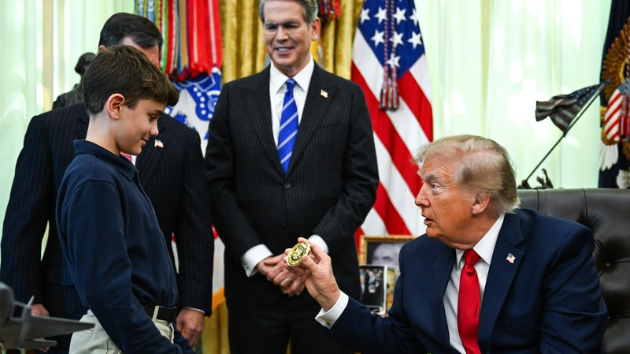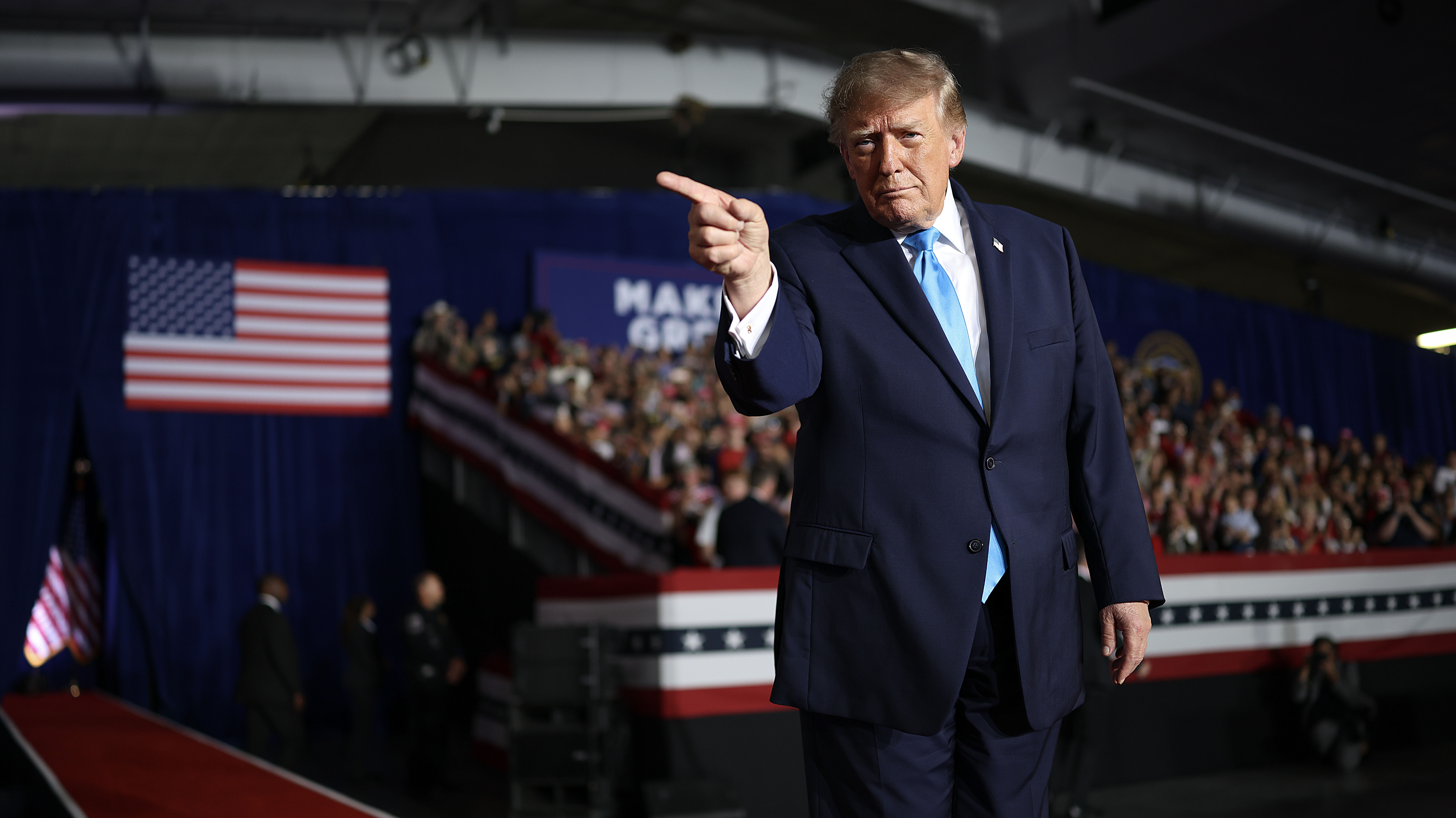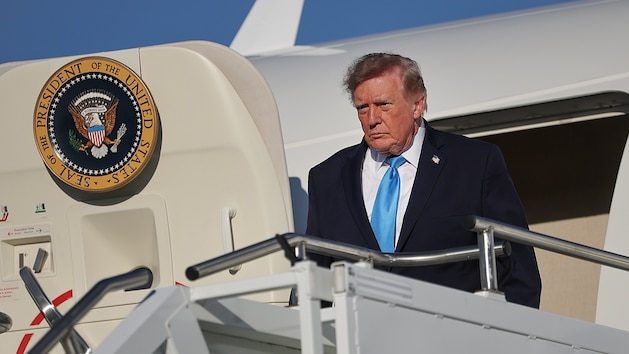




US President Donald Trump during an executive order signing ceremony in the Oval Office of the White House in Washington, DC, US, on Thursday, April 30, 2026. Trump signed an executive order aimed at expanding access to retirement plans for workers whose employers don't offer that benefit, seeking to refocus the administration's messaging on economic issues. (Photographer: Aaron Schwartz/CNP/Bloomberg via Getty Images)
(WASHINGTON) -- With Iranian forces attacking commercial vessels near the Strait of Hormuz and oil infrastructure in the United Arab Emirates, President Donald Trump on Monday stopped short of saying the U.S.-Iran ceasefire has been violated.
"[It was] not heavy firing," Trump said in a phone call with ABC News when asked if the ceasefire had been violated. "We'll let you know. Ships are moving. You know, we moved quite a few last night -- big ones. There was no firing. I guess there has been some recently. I'm looking into it."
Over the past several hours, Iran fired on a South Korean ship near the Strait of Hormuz, and fired missiles and drones on the UAE. Plus, according to CENTCOM, U.S. forces fired on six Iranian fast boats and intercepted several Iranian missiles and drones.
Trump told ABC that "Iran "better hope [the ceasefire] remains in effect. The best thing that can happen to them is that we keep it in effect."
And what happens if the ceasefire is broken?
"I'll let you know, like I'll let everyone else know," the president said. "We just heard about this, and we'll find out about it. What should happen is South Korea should get involved. It was a South Korean ship that got hit. And I would think, if you have a ship that's hit, you should immediately send some people."
"Right now, we we're being very nice. We're taking care of the world," Trump added.
On the Iran's firing of missiles and drones at the UAE, Trump said "they were shot down for the most part."
"One got through. Not huge damage," he said.
So we shouldn't overreact?
"Overreacting is very bad for them," Trump said. "Not for me."
And what does this all mean about the prospects for ending the war?
"We have it under control," Trump said. "One way or the other, we win. And you know why, Jon? I always win. You found that out a long time ago."
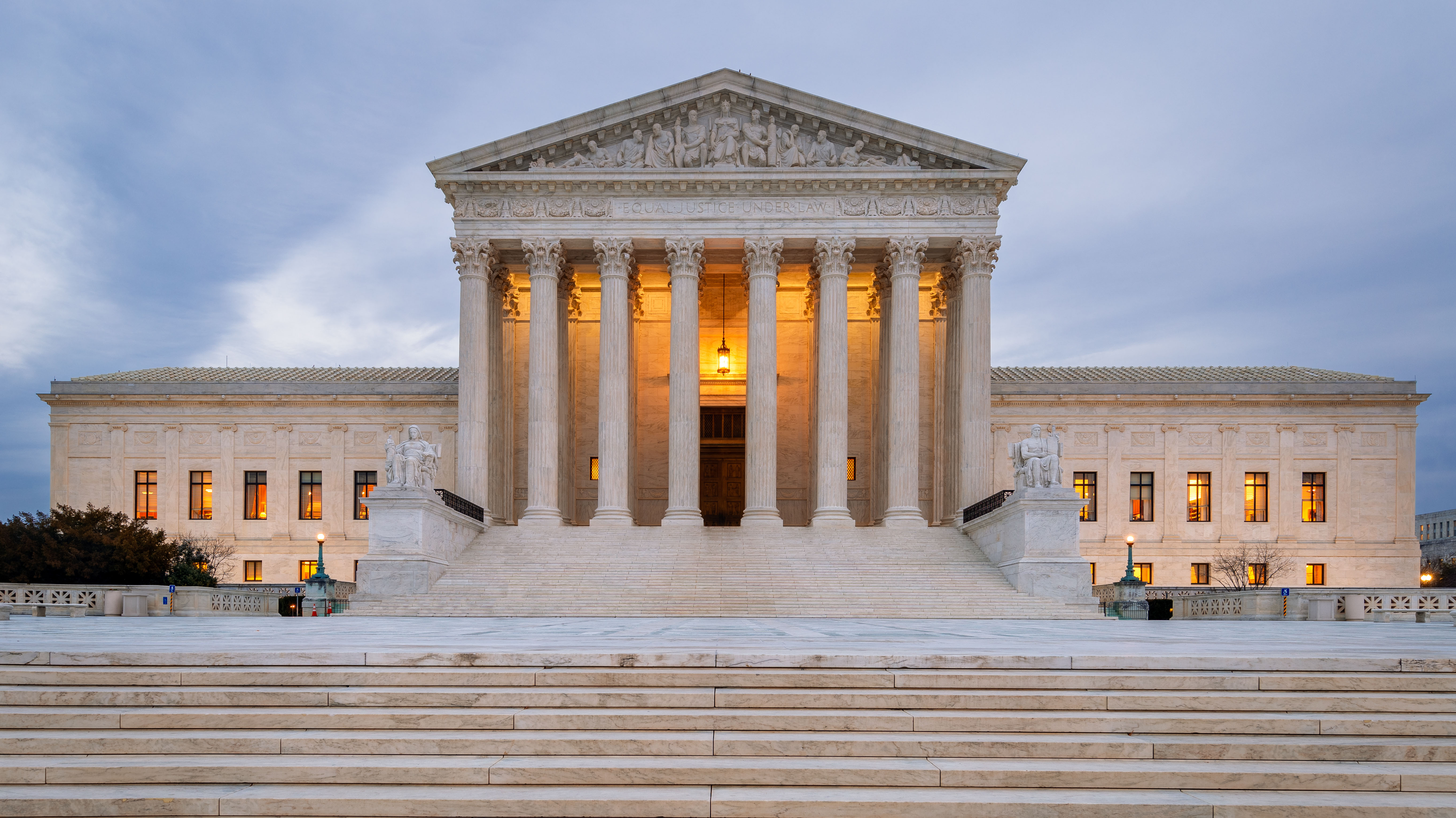
The U.S. Supreme Court building on May 4, 2026 in Washington, DC. (Andrew Harnik/Getty Images)
(WASHINGTON) -- Justice Samuel Alito on Monday issued an administrative stay of a lower court order that had rolled back access to mifepristone nationwide.
The move restores expanded access to the abortion pill without the need for an in-person doctor's visit, for now. The pill can once again be prescribed via telemedicine and obtained via mail or pharmacy, a practice approved by the Food and Drug administration in 2023.
Justice Samuel Alito did not explain his decision.
The order from Alito is set to expire May 11, suggesting the full court will act by that time on whether to grant an extended stay of the lower court ruling as litigation over the safety of mifepristone guidelines continues.
The state of Louisiana, which bans abortion at all stages of pregnancy with limited exceptions, originally brought the case in a bid to block mail-order access to the abortion pill, alleging federal regulators did not properly consider safety risks when discontinuing an in-person doctor visit requirement.
Drug makers, public health organizations and abortion rights advocates insist legally mandated reviews were conducted and that the drug has a lower adverse effects rate than penicillin and Viagra.
The 5th U.S. Circuit Court of Appeals, which Alito oversees, on Friday issued a nationwide order barring the commonly used abortion drug from being dispensed by telehealth providers or distributed by mail as litigation continues. The order was effective immediately.
The two primary makers of mifepristone, Danco Laboratories and GenBioPrio, on Saturday asked the Supreme Court to lift a lower court’s ruling.
"The resulting chaos for patients, providers, pharmacies, and the drug-regulatory system is a quintessential irreparable harm that underscores the need for emergency relief from this Court," lawyers for Danco Laboratories wrote in their filing.
In 2024, the Supreme Court unanimously rejected a similar legal challenge to mifepristone, concluding that the doctors and anti-abortion groups who sued over the drug did not have standing.
Former New York City Mayor Rudy Giuliani attends the annual 9/11 Commemoration Ceremony on Sept. 11, 2025 in Manhattan. (Barry Williams/New York Daily News/Tribune News Service via Getty Images)
(NEW YORK) -- Rudy Giuliani is hospitalized in critical condition and "is recovering from pneumonia" after being on ventilator, his spokesman said.
The 81-year-old former New York City mayor is critical but stable, spokesman Ted Goodman said in a statement on Sunday.
He "is being monitored as a precautionary measure," Goodman said in a followup statement on Monday.
Giuliani served as New York City's mayor from 1994 to 2001. Goodman noted in Monday's statement that Giuliani "ran toward the towers to help those in need" on Sept. 11, 2001, "which later led to a diagnosis of restrictive airway disease."
"This condition adds complications to any respiratory illness, and the virus quickly overwhelmed his body, requiring mechanical ventilation to maintain adequate oxygen and stabilize his condition," he said. "He is now breathing on his own, with his family and primary medical provider at his side."
Restrictive lung disease refers to a group of conditions where the lungs can’t fully expand, so people take in less air and often feel short of breath, according to the CDC.
After his term as mayor, Giuliani was a personal lawyer to President Donald Trump, who wrote about Giuliani's hospitalization in a social media post on Sunday. The president called Giuliani "a True Warrior, and the Best Mayor in the History of New York City, BY FAR."
A spokesperson for Eric Adams, who was the city's mayor from 2022 to 2025, noted Giuliani's service in a statement.
"From his years as a federal prosecutor to leading New York City through its darkest day on 9/11, he stood with this city when it needed him most," Adams spokesperson Todd Shapiro said.
People with restrictive lung disease face a higher risk of pneumonia because stiff or scarred lungs make it harder to clear mucus and fight infection.
There are about 650,000 cases of interstitial lung diseases in the U.S. Various conditions that fall within this diagnosis are linked to 9/11 exposure and are covered by the World Trade Health program.
- ABC News' Isabella Murray, Darren Reynolds and Liz Neporent contributed to this report.
Fernando Mendoza #15 of the Indiana Hoosiers dives for a fourth quarter touchdown against the Miami Hurricanes in the 2026 College Football Playoff National Championship at Hard Rock Stadium on January 19, 2026 in Miami Gardens, Florida. (Photo by Carmen Mandato/Getty Images)
(WASHINGTON) -- The Indiana Hoosiers -- 2025 College Football Playoff national champions -- will visit the White House on Monday, May 11, according to a source familiar with the team's plans.
It's unclear whether former Indiana quarterback and Heisman Trophy winner Fernando Mendoza will attend. Mendoza was the first player chosen in April's NFL draft.
ABC News reached out to the White House about the upcoming visit but did not receive an immediate response.
Led by a late-game touchdown run by Mendoza, the Hoosiers' undefeated season was capped off in storybook fashion this past January, when the team defeated the Miami Hurricanes 27-21 for their first-ever championship.
Indiana Head Coach Curt Cignetti is also expected to attend.
The White House trip is an honor bestowed to the championship winning teams in both college and professional sports. It's often coupled with visits to Capitol Hill but the source couldn't determine whether the team's schedule would feature a trip to Congress.
President Donald Trump welcomed several NCAA collegiate champions to the White House last month.
The Hoosiers' expected visit comes amid Trump's efforts to "save" college sports. The president signed an executive order last month urging Congress to "expeditiously" pass legislation that addresses the future of competition and opportunity in all college sports, especially football and basketball.
Meanwhile, the Hoosiers championship also comes as name, image, and likeness (NIL) deals have been scrutinized by the White House and lawmakers in Washington concerning pay-for-play and player eligibility.
Looking to repeat as national champions, the Hoosiers finished spring practice last week with a reloaded squad that features top transfer portal pickups, quarterback Josh Hoover and wide receiver Nick Marsh.
U.S. President Donald Trump boards Air Force One on April 24, 2026 at Joint Base Andrews, Maryland. (Roberto Schmidt/Getty Images)
(WASHINGTON) -- President Donald Trump announced Friday that he will increase tariffs on European Union cars and trucks to 25% next week, claiming in a social media post that the EU is "not complying with our fully agreed to Trade Deal."
"Based on the fact the European Union is not complying with our fully agreed to Trade Deal, next week I will be increasing Tariffs charged to the European Union for Cars and Trucks coming into the United States. The Tariff will be increased to 25%," Trump wrote in a post to his social media platform.
While the president did not specify what tariff authority he was invoking, it appears that the administration will use Section 232, which authorizes him to "adjust the imports" of goods that the secretary of commerce finds to have been imported in a manner that threatens U.S. national security.
Trump, departing the White House Friday afternoon, reiterated that the tariff was coming because "as usual, they were not adhering to the agreement that we have."
ABC News has reached out to the White House for additional comment on tariff authority.
Trump, in his social media post, touted American automobile production capabilities, claiming that U.S. manufacturing plants "will be opening soon" and that "over 100 Billion dollars" is being invested, though he did not say where the alleged money was coming from.
"It is fully understood and agreed that, if they produce Cars and Trucks in U.S.A. Plants, there will be NO TARIFF. Many Automobile and Truck Plants are currently under construction, with over 100 Billion Dollars being invested, A RECORD in the History of Car and Truck Manufacturing," Trump added in his post.
This is a developing story. Please check back for updates.
Guided-missile destroyer USS Rafael Peralta enforces the U.S. blockade of Iranian ports against M/T Stream after it attempted to sail to an Iranian port, April 26, 2026. (U.S. Central Command)
(WASHINGTON) -- The Trump administration is seeking the participation of other countries to form an international coalition to help reopen the Strait of Hormuz, according to an internal cable sent this week by the State Department to posts around the world.
Dubbed the "Maritime Freedom Construct," the coalition would help with coordinating diplomatic efforts, including aligning on sanctions and information sharing to help with safe transit through the waterway, according to a U.S. official.
The cable called on diplomats to announce the formation of the new coalition and "ask for partner participation" by Friday.
The Maritime Freedom Construct would take steps to ensure safe passage, including providing real-time information, safety guidance, and coordination to ensure vessels can transit the waters securely, the cable said.
The Wall Street Journal first reported on the cable.
"The MFC's efforts will enhance maritime domain awareness and support the safe passage of commercial operators and their crews," a State Department official said.
The United Kingdom and France have already launched a multilateral effort involving 30+ nations toward securing the strait that could eventually involve deploying military assets if a peace deal is reached, according to those countries' governments.
However, last week during a Pentagon press briefing, Defense Secretary Pete Hegseth mocked the European efforts, saying Europe might want to start having "less fancy conferences in Europe and get in a boat."
He dismissed the U.K. and French effort aimed at ensuring the future security of the critical Gulf waterway as "silly."
"Europe and Asia have benefited from our protection for decades, but the time for free-riding is over," he said.
Shahram Irani, Iran's Navy commander, called the U.S. blockade "piracy" and the U.S. as "maritime terrorists."
"The Strait of Hormuz is closed from the Arabian Gulf, meaning they have no right of passage from there, and there is no entry. As soon as they come, operational and tactical action is taken against them," he said.
He went on to call the blockade piracy and american actions as "maritime terrorists"
On Thursday, United Nations Secretary General Antonio Guterres warned the consequences of continued disruptions to the global energy supply caused by the Iran war and the closure of the strait "grow worse with each passing hour."
Guterres the worst-case scenario could be "the specter of a global recession" if disruptions to the strait continue through 2026. Even in the best case, if restrictions were relieved today, "supply chains will take months to recover" and warned that developing countries will be hit the hardest by economic instability.
According to the cable, the coalition will be led by the departments of State and Defense through U.S. Central Command.
The State-led component, based in Washington, D.C., will serve as the diplomatic operations hub, uniting partners and the commercial shipping industry. The Pentagon component operating out of CENTCOM headquarters in Florida would coordinate real-time maritime traffic and communicate directly with vessels transiting the Strait, the cable said.
"It will provide a platform to coordinate diplomatic actions and socialize and align economic measures designed to impose costs on Iran for disrupting maritime security," the State official said.
ABC News' Desiree Adib contributed to this report.
Secretary of Defense Pete Hegseth testifies during the Senate Armed Services Committee hearing on the Defense Department's budget request on Thursday, April 30, 2026. (Bill Clark/CQ-Roll Call, Inc via Getty Images)
(WASHINGTON) -- Defense Secretary Pete Hegseth told a Senate committee on Thursday that dissent from the "cheap seats" in Congress sought to undermine the military's efforts in its war in Iran only two months into the campaign.
"Defeatists from the cheap seats who, two months in, seek to undermine the incredible efforts that have been undertaken and the historic nature of taking on a 47-year threat," Hegseth said in his opening statement.
The statement was similar to what he told the House Armed Services Committee on Wednesday in the first of two hearings on the Pentagon's 2027 budget plan in which he faced questions on the war in his first public appearances before Congress since the war started in February.
In both hearings, Hegseth asserted the the U.S.'s "biggest adversary" in the war is from within.
"Unfortunately, as I said yesterday, and I'll say it again today, the biggest adversary we face at this point are the reckless naysayers and defeatist words of congressional Democrats and some Republicans," he said.
Hegseth later told Democratic Sen. Richard Blumenthal, "It's defeatist Democrats like you that cloud the mind of the American people" and "otherwise fully support" not preventing Iran from pursuing a nuclear weapon.
The hearings were scheduled to discuss the Pentagon's request for a $1.5 trillion budget for 2027, the most the Pentagon has ever requested. In Wednesday's hearing, Jules Hurst III, the Pentagon comptroller, testified the war has so far cost $25 billion. The Pentagon has said it will ask for $200 billion in supplemental funding for the campaign, though on Thursday Hegseth denied the request would be that much.
In both hearings, Hegseth asserted the the U.S.'s "biggest adversary" in the war is from within.
"Unfortunately, as I said yesterday, and I'll say it again today, the biggest adversary we face at this point are the reckless naysayers and defeatist words of congressional Democrats and some Republicans," he said.
Democratic Rep. Chrissy Houlahan pushed back against Hegseth's assertion on Wednesday, telling him, "Mr. Secretary, you reserved more words and more time and more vitriol to condemn Democrats than you did for [Chinese President Xi Jinping] and for [Russian Federation President Vladimir] Putin combined. It's pretty telling to me that you decided to use your words and your time for that."
Leaving Thursday's hearing, Blumenthal told reporters, "Secretary Hegseth seems to feel that by attacking the committee, he somehow is persuading the American people. "It's exactly the opposite -- his antagonism and seeming reluctance to tell the truth, I think, is doing this administration and the country a tremendous disfavor. And by refusing to come clean, give us precise numbers on costs, when we know that the true figures are higher than what has been told us, I think just undermines his credibility."
Democrats and some Republicans in Congress have questioned the rationale behind launching the campaign against Iran, its endgame and the strains it has put on the economy and alliances with U.S. partners.
Democratic Sen. Kirsten Gillibrand challenged Hegseth over the Trump administration's premise that an attack on the U.S. by Iran was imminent.
"There's no evidence that we are safer because of this war. We did not have any evidence that Iran intended to imminently attack this country in any way, shape or form. So, I disagree with your assessment that we are under threat," she said.
"Do you not believe them when they say 'Death to America'?" Hegseth asked.
"Listen, our adversaries use rhetoric all the time. What I'm concerned about is we are not safer," she responded.
The war's impact on Iran and the U.S.
Sen. Jack Reed, the ranking Democrat on the committee, said that the war has put the U.S. "in a worse strategic position," pointing out that the Strait of Hormuz had closed because of the war and Iran's nuclear material remained unaddressed and telling Hegseth his declaration of victory on April 8 was premature.
"Mr. Secretary, I am concerned that you have been telling the president what he wants to hear, instead of what he needs to hear," Reed said. "Bold assurances of success are a disservice to both the commander-in-chief and the troops who risk their lives based on them. Our military has performed heroically. But military force without a sound strategy is a path to long-term defeat."
Reed also said cultural erosion has taken place in the military and would lead to "lasting harm." He pointed to Kid Rock's recent "joy ride" with Hegseth in Army attack helicopters, the firing of several senior officers, and "troubling" statements he said the secretary had made about the conduct of the war.
"You have made troubling statements about showing 'no mercy' and 'no quarter' to the Iranians: orders that would constitute war crimes," Reed said.
He later revealed some figures from unclassified assessments, saying, "Iran retains more than 40% of its drone arsenal and 60% of its ballistic missile launches, compared with prewar levels.
Hegseth said Trump seized "an opportunity" to attack Iran in a weak position.
"Our military objectives have been stunningly effective," he said. "So we've put the president in a very strong position to ensure Iran never gets a nuclear weapon. That's, that's the takeaway, that's been underneath every single aspect of this."
Firings of Pentagon officials
Reed also pressed Hegseth on the firings of a number of senior military leaders. Nearly two dozen have been fired or sidelined under Hegseth, by ABC News' count.
"Did the president direct you to single out female and Black officers to be dismissed?" Reed asked.
"Senator, of course not. And as we've emphasized at this department from the beginning, the only metric is merit," Hegseth fired back.
Reed said he thought Hegseth's personnel decisions reflected bigotry and followed a religious- instead of merit-based interest.
"I think that direction from your behavior is an intense interest in Christianity, in nationalism and in not recognizing the talents of women and nonwhite gentlemen. And that's the wrong direction," Reed said.
"I don't know what you're insinuating, Senator, but I am not ashamed of my faith in Jesus Christ," Hegseth said.
Reed agreed he "shouldn't be" ashamed, but was skeptical whether the secretary was "neutral" about faith-based decisions.
"I am a believer. I'm quite open in that," Hegseth responded. "And our department allows for a multitude of faiths, so I don't, I don't know what you're suggesting. I've heard the likes of things that people like you suggest to try to smear my character and I won't give in to it."
Sen. Joni Ernst, one of a small number of Republicans who have expressed frustration with the dismissals, told Hegseth "I was disappointed that their retirements were hastened by you and the administration," pointing to the departures of former Army chief of staff Gen. Randy George and former Army vice chiff of staff Gen. James Mingus.
Threats from others
Gen. Dan Caine, chairman of the Joint Chiefs of Staff, appeared to agree with Senate Armed Services Chairman Roger Wicker's assertion that Russia has tried to to undermine the U.S. operation in Iran.
"General Caine, there's no question that Vladimir Putin's Russia is taking serious action to undermine our efforts for success in Iran. Is there any question about that?" Wicker asked.
"I think there's actions and activities. [I'm] mindful of the hearing room we're in, but there's, there's, there's definitely some action there," Caine said. Wicker described the war against Iran as a success.
Wicker said Iran was part of an axis of aggressors with China, Russia and North Korea.
"This growing alliance cannot be denied," the chairman said, adding later that "ties have never been closer among these fou. ... dictatorships."
War Powers Resolution
Democratic Sen. Tim Kaine invoked the War Powers Resolution, which holds that the administration has 60 days to conduct military operations then must either inform Congress it needs an additional 30 days to wind down operations, or begin bringing forces home.
Hegseth indicated that was not applicable because the clock stopped during the current ceasefire between the U.S. and Iran.
"We are in a ceasefire right now, which our understanding means the 60-day clock pauses or stops in a ceasefire," the secretary said.
Kaine said that was dubious.
"I do not believe the statute would support that. I think the 60 days runs, maybe tomorrow, and it's going to pose a really important legal question for the administration ... we have serious constitutional concerns and we don't want to layer those with additional statutory concerns," he said.
The 1973 War Powers Resolution gives the president latitude to conduct military strikes for a 60-day window, which closes Friday. The law allows for a one-time 30-day extension for the president to act without the consent of lawmakers.
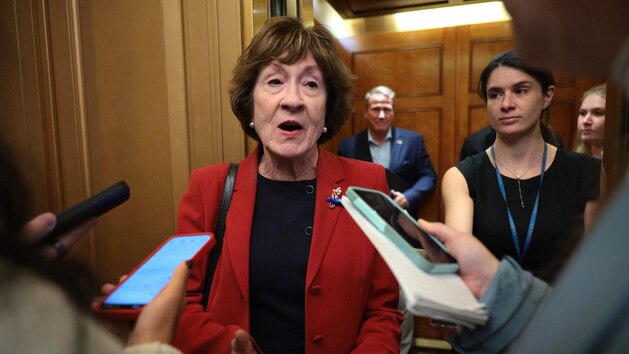
For the sixth time, the Senate on Thursday failed to advance an Iran War Powers Resolution by a vote of 50-47, though in a sign that more Republicans could start to flip as the marker is surpassed, GOP Sen. Susan Collins for the first time voted with Democrats in favor of advancing the legislation.
Strikes on alleged drug-carrying boats
Kaine also said he'd seen classified legal rationales for strikes on boats allegedly smuggling drugs in the Caribbean Sea and eastern Pacific Ocean and the facts of nearly 50 of those operations. He said there was a "profound mismatch" between the targeting criteria and the military actions taken.
Kaine encouraged his colleagues to read targeting criteria and get briefed about it, and at the files of all the strikes that have taken place.
"I've done that with the first 46 strikes or so, and I think there's a profound mismatch between what is occurring and the underlying assumptions in the legal opinion. And I would just encourage my colleagues to dig into this."
Hegseth said the targeting was not "willy-nilly," likening the alleged drug traffickers to al Qaeda.
The US Capitol is seen, April 20, 2026 in Washington. (Leigh Vogel/Getty Images)
(WASHINGTON) -- After months of resistance, the House on Thursday passed the Senate-backed Department of Homeland Security funding bill, which funds all agencies inside DHS except immigration enforcement operations.
The bill passed via voice vote. There was no recorded vote requested.
The measure now heads to President Donald Trump's desk now for signature -- effectively ending the record-long DHS shutdown after 76 days. Trump will sign the funding bill later Thursday, according to a White House official.
DHS Secretary Markwayne Mullin had warned extra funding to pay his department's employees would have "dried up" by the first week of May.
The House took action just before Congress leaves for a weeklong recess.
"This will relieve pressure from the Department of Homeland Security," Johnson told reporters after the vote. "We're not going to have lines at TSA. Everybody will get their paychecks now. We'll get moving forward."
While the package funds most of DHS -- the Transportation Security Administration, the Federal Emergency Management Agency, the Coast Guard, the Secret Service and the Cybersecurity and Infrastructure Security Agency -- it does not include funding for Immigration and Customs Enforcement and parts of Customs and Border Protection.
Republicans are working on a separate budget bill to fund those agencies through reconciliation, a process that will allow them to pass legislation without any Democratic support.
Late Wednesday night, House Republicans narrowly approved a budget blueprint that would provide billions of dollars to ICE and CBP, funding the agencies for the remainder of Trump's term.
Trump set a June 1 deadline for Republicans to fund the immigration enforcement agencies.
The DHS funding fight kicked into high gear after two American citizens were fatally shot by federal agents during Trump's immigration crackdown in Minneapolis.
Democrats said they would not support funding without significant reforms to ICE and CBP's operating procedures. But talks between Democrats and the White House in March ultimately yielded no breakthrough.
"Democrats got absolutely nothing for their political charade and shenanigans," Johnson said on Thursday.
Sen. Chuck Schumer, the chamber's top Democrat, criticized Johnson for waiting weeks to vote on the DHS funding bill that passed the Senate by unanimous consent on March 27.
"Over a month of unnecessary pain for millions of Americans brought to you by the House GOP," Schumer posed on X.
House Minority Leader Hakeem Jeffries said the House GOP "kept the Department of Homeland Security shut down because of their toxic demand to spend billions of taxpayer dollars on ICE brutality."
ABC News Capitol Hill Correspondent Jay O'Brien pressed Johnson on why the House didn't act on the measure sooner. The speaker defended his decision to stall the vote, saying he waited until Republicans passed the budget resolution for ICE and CBP before moving on funding for the rest of DHS.
"They wanted to orphan these two critical agencies that are under the umbrella of Homeland Security, I remind everybody on the Hill all the time, Department of Homeland Security is the third-largest department of the federal government. It has critical responsibilities," Johnson said.
Nicole Saphier attends the Patriot Awards, December 5, 2024 in Greenvale, New York. (Theo Wargo/Getty Images)
(WASHINGTON) -- President Donald Trump said on Thursday that he is nominating Dr. Nicole Saphier to be the next surgeon general.
Trump made the announcement on social media, calling Saphier a "STAR physician who has spent her career guiding women facing breast cancer through their diagnosis and treatment while tirelessly advocating to increase early cancer detection and prevention."
Saphier is the director of breast imaging at Memorial Sloan Kettering Monmouth in New Jersey and a regular medical contributor on Fox News.
According to her profile on the Memorial Sloan Kettering website, she has experience "performing minimally invasive, image-guided procedures of the breast, kidney, pancreas, liver, thyroid and lymph nodes."
Her nomination comes just two months after Trump's previous nominee, Dr. Casey Means, appeared before the Senate Health, Education, Labor and Pensions (HELP) committee for her confirmation hearing.
During the hearing, Means indicated she supports vaccines but stopped short of recommending certain shots.
Means, who has a medical degree but does not hold an active medical license, appeared hesitant to say that some vaccines, such as the flu vaccine, prevent serious disease.
Sen. Bill Cassidy, who chairs the HELP committee and is a physician, noted that two children died last year from measles and pushed Means on whether she would encourage parents to vaccinate their children with the measles, mumps and rubella (MMR) vaccine.
Means initially stressed personal autonomy and responded that she supported vaccination and that every patient should have a conversation with their doctor about getting vaccinated.
This is a developing story. Please check back for updates.
Louisiana Governor Jeff Landry speaks in the Roosevelt Room of the White House March 24, 2025 in Washington, DC. (Win McNamee/Getty Images)
(WASHINGTON) -- Louisiana Gov. Jeff Landry and Louisiana Attorney General Liz Murrill on Thursday said that the Supreme Court’s ruling on Wednesday against the state's congressional map means that the planned May 16 congressional primaries won’t proceed as scheduled as lawmakers consider drawing a new map.
"The Supreme Court previously stayed an injunction against the State’s enforcement of the current Congressional map. By the Court’s order, however, that stay automatically terminated with yesterday’s decision. Accordingly, the State is currently enjoined from carrying out congressional elections under the current map. We are working together with the Legislature and the Secretary of State’s office to develop a path forward," they wrote in the statement.
Landry told at least some Republican House candidates in Louisiana that he plans on Friday to suspend the state's primaries, according to multiple Republican sources.
A Republican source told ABC News that the governor called one candidate on Wednesday and said he is making calls to all of the candidates that he plans on Friday to suspend the election using executive power. The Washington Post was first to report about the governor's calls.
The source said it was unclear if this will apply to all of the planned primaries, which include a closely watched Senate primary, or just the primaries for the House that would be impacted by a new congressional map.
ABC News has reached out to Landry's office and the office of the Louisiana secretary of state.
The Supreme Court's ruling on Wednesday reverses lower court decisions that said Louisiana's map, drawn after the 2020 census, violated the Voting Rights Act because only one of six districts was majority Black. More than a third of the state's voting age population is Black.
Those courts had ordered Louisiana to add a second majority-Black district, a process which in turn explicitly relied on race. In his opinion, Justice Samuel Alito said that move infringed on the rights of white voters under the 14th Amendment's equal protection clause.
Absentee ballots in Louisiana have already been sent out, and votes have likely been cast, although early voting in person does not start until Saturday, May 2. Absentee voting is relatively limited in Louisiana and requires a valid excuse.
Democratic Rep. Troy Carter from Louisiana said on Wednesday at the Congressional Black Caucus press conference that elections are too close at this point for congressional maps to change.
“We are in the 2026 election cycle now. The Supreme Court has set precedent just four years ago in a case in Louisiana, they ruled the district to be unconstitutional, said it's too close to the election now, therefore we will do it in the next cycle," Carter said, later adding that "if precedent matters, then clearly this is something that will have to be taken up in 2028 cycle, not the 2026."
But the Louisiana's existing map cannot be used, according to the Supreme Court's ruling. Technically the state could revert back to its original 2022 map with one majority-Black district or redraw a new map entirely. Some legal experts have argued Louisiana could still keep its current map for the May primaries.
On Thursday, Murrill put in a filing with the Supreme Court saying, "Louisiana currently 'is prohibited from using SB8’s map of congressional districts for any election'. The Governor and Attorney General are thus working with the Legislature-- which is in session until June 1 -- to immediately produce a constitutional map and electoral process for Louisiana."
On Wednesday, Landry praised the ruling, but declined to say if it would have an impact on those primaries or not.
"Look, I think that anyone who jumps to conclusions right now -- I think it's going to take us at least 24 hours to really pore through the opinion to understand what exactly that opinion is telling us," he told reporters. But he left the option open to a map redraw: "I mean, look, the Supreme Court picked an interesting time to be able to drop that on us… the court decides to give it to us on the eve of the election. What are they telling us? Are they telling us we have to draw? Telling us we don't have to draw?"
ABC News' Devin Dwyer and Hannah Demissie contributed to this report.
U.S. President Donald Trump speaks in the Oval Office after signing an Executive Order April 18, 2026 in Washington, DC. (Tasos Katopodis/Getty Images)
(WASHINGTON) -- President Donald Trump doubled down on his claim that the term "86" is a "mob term" for a killing as former FBI Director James Comey faces a federal indictment over a social media post of seashells arranged to read "86 47."
"'86' is a mob term for 'kill him.' They say 86 him! '86 47' means 'kill President Trump,'" Trump wrote in a social media post Wednesday night, before going on to assail Comey as a "Dirty Cop" who "knows this full well!"
Comey, who was indicted on Tuesday by a federal grand jury in North Carolina, made an initial court appearance on Wednesday after self-surrendering to law enforcement at the courthouse in the Eastern District of Virginia. Comey did not enter a plea.
The former FBI director, who was fired in 2017 by Trump during the president's first term, faces one charge of threats against the president and successors, and one charge of transmitting a threat in interstate commerce.
The indictment centers on a controversy that erupted nearly a year ago when Comey, in a since-deleted Instagram post, shared a picture showing the numbers "86 47" written in seashells on the beach with the caption "Cool shell formation on my beach walk."
"EIGHT MILES OUT, SIX FEET DOWN! Didn’t he also lie to the FBI about this??? I think so!" Trump said on Wednesday night, describing his apparent interpretation of what the eight and six represent.
The Merriam-Webster dictionary, which lists several definitions of "eighty-six," says the most common use for the informal saying is to describe a way "to refuse to serve" or "to eject or ban" a customer from a restaurant or bar. The dictionary says it's often used as a way to say something has been removed. The American Heritage dictionary says the term may have derived as a rhyming slang for "nix."
The origin of the president’s assertion that the term comes from the mob is unclear. A search of scripts from the American Film Institute's top 10 gangster films shows no instance of the phrase being used, despite Trump referring reporters to mob movies on Wednesday.
"You ever see the movies? '86 ’em' -- the mobster says to one of his wonderful associates, '86 'em.' That means kill 'em. It’s -- I think of it as a mob term," he said.
Republican Sen. Thom Tillis said he did some of his own research on the term.
"I searched to the end of the internet last night, I can't find one example where the number 86 had anything to do with any violent threat. So hopefully there's more to it than just the picture in the sand," Tillis told reporters on Wednesday. "Otherwise, I just think it's another example of where we're going to regret this because we're setting a fairly low bar and political physics, like I've said around here for years, is what it is. For every action, there's an equal and opposite reaction."
Tillis later added, "maybe there's deep history in the use of this word and communicating threats. I just can't find it anywhere."
The Department of Justice in announcing that the indictment that had been handed up said that "a reasonable recipient [of Comey's image] who is familiar with the circumstances would interpret as a serious expression of an intent to do harm to the President of the United States."
And while the president has repeated his claim that Comey's post was a call for him to be killed, Trump appeared to hedge when asked directly Wednesday whether he believed his life was in danger.
"Probably, I don’t know," he said. "You know, based on -- based on what I’m seeing out there, yeah."
U.S. Speaker of the House Mike Johnson (R-LA) speaks at a press conference at the U.S. Capitol on April 21, 2026 in Washington, DC. (Kevin Dietsch/Getty Images)
(WASHINGTON) -- After drama and delay, House Republicans narrowly approved a blueprint for legislation to fund immigration enforcement agencies, the first step in the GOP's plan to reopen the Department of Homeland Security.
The party-line vote, which was held open for more than five hours, was called at 10:39 p.m. on Wednesday after Speaker Mike Johnson and Republican leaders huddled with holdouts.
Reps. Harriet Hageman of Wyoming, Andrew Clyde of Georgia, Andy Harris of Maryland, Michael Cloud of Texas and Victoria Spartz of Indiana flipped their votes to yes after hours of discussion. Rep. Kevin Kiley of California, an Independent who conferences with Republicans, voted present.
The final vote was 215-211-1.
The budget resolution kicks off the drafting process of a bill that Republicans said would provide billions of dollars to Immigration and Customs Enforcement and Customs and Border Protection for the remainder of President Donald Trump's term.
Trump has set a June 1 deadline for Republicans to fund the immigration enforcement agencies.
Republicans are using reconciliation, a lengthy and complex process, to overcome Democratic opposition.
Democrats have said they won't support funding for ICE and CBP without reforms to their operating procedures, after two American citizens in Minneapolis were fatally shot by federal agents earlier this year.
DHS has been shut down since mid-February, making it the longest shutdown in U.S. history.
The shooting at the White House Correspondents Association dinner at the Washington Hilton on Saturday rekindled the DHS funding fight. White House press secretary Karoline Leavitt called the funding lapse a "national emergency."
But it's currently unclear when House Republican leaders plan to put a Senate-passed bill to fund the rest of DHS on the floor for a vote.
Janet Mills, governor of Maine and Democratic US Senate candidate, during a roundtable discussion with community leaders in Westbrook, Maine, US, on Tuesday, March 10, 2026. (Photographer: Sofia Aldinio/Bloomberg via Getty Images)
(NEW YORK) -- Maine Gov. Janet Mills announced Thursday morning that she is suspending her U.S. Senate campaign, leaving Graham Platner as the likely Democratic nominee to face off against incumbent Republican Sen. Susan Collins.
Mills cited financial resources as a reason for suspending her campaign.
“While I have the drive and passion, commitment and experience, and above all else -- the fight -- to continue on, I very simply do not have the one thing that political campaigns unfortunately require today: the financial resources,” Mills said in a prepared statement. “That is why today I have made the incredibly difficult decision to suspend my campaign for the United States Senate."
The latest Federal Election Commission filings from Q1 show Planter raised roughly $1.4 million more than Mills and has roughly $1.7 million more cash on hand.
Platner, an oyster farmer and military veteran, also regularly polled significantly higher than Mills.
Mills' announcement came just one day before the Maine Democratic Convention was scheduled to begin -- and more than five weeks before the state's June 9 primary.
Mills and Platner were scheduled to participate in their first televised debates of the campaign in May alongside David Costello.
Sen. Bernie Sanders supported Platner, while Sen. Chuck Schumer had previously announced his endorsement of Mills.
In a statement issued Thursday morning by the Democratic Senatorial Campaign Committee, Schumer and Sen. Kirsten Gillibrand said in part, “After years of allowing Trump’s abuses of power, Senator Collins has never been more vulnerable and we will work with the presumptive Democratic nominee Graham Platner to defeat her.”
ABC News' Hannah Demissie contributed to this report.
(FLORIDA) -- Florida's state legislature passed a new congressional map on Wednesday that could allow Republicans to flip up to four seats.
It now goes to Republican Gov. Ron DeSantis, who had proposed it earlier this week after teasing mid-decade redistricting for months. The governor has argued that Florida's population growth and other legal issues meant the state had to redraw its map.
The new map, analysts say, could leave just four Democratic-held districts in the state after the 2026 midterms.
But it's likely to face legal challenges, particularly because the Florida Constitution has what are known as the Fair Districts Amendments, which prohibit drawing congressional districts "with the intent to favor or disfavor a political party or an incumbent" and includes protections for minority voters and keeping districts contiguous.
Representatives for DeSantis have argued that the Fair Districts Amendments, approved by voters in 2010, are faulty.
But Democrats have been adamant that the process of considering the map was rushed, and that the mid-decade redistricting gambit will be found illegal by courts.
"This is a map that is designed and intended to rig outcomes, and to benefit one political party, the Republican Party, Donald Trump's Republican Party, in direct violation of Florida's constitution," Democratic state Sen. Carlos Guillermo Smith said on Wednesday ahead of the vote.
Republican Party of Florida Chair Evan Powers said "Florida got it right."
"Governor Ron DeSantis and our Legislature have delivered congressional maps that reflect the continued growth of our state that are fair, and constitutional, ensuring Florida voters are represented accurately," Powers said in a statement on Wednesday.
Some Republican members of Florida’s U.S. House delegation had previously expressed concerns that a map redraw could backfire for the GOP, weakening incumbents while galvanizing Democratic voters.
The passage of Florida's new map came on the same day that the U.S. Supreme Court struck down Louisiana's congressional map as an unconstitutional racial gerrymander and dealt a blow to Section 2 of the Voting Rights Act.
DeSantis and his team argued that the case and ruling lent credence to Florida redrawing its map.
The new Florida map also comes roughly a week after Republicans faced a loss when Virginia voters approved allowing a new congressional map there that could let Democrats flip up to four seats. The results of that election are currently held up in court.
ames Comey speaks onstage at 92NY on May 30, 2023 in New York City. (Photo by Dia Dipasupil/Getty Images)
(WASHINGTON) -- Former FBI Director James Comey made an initial court appearance Wednesday after self-surrendering to law enforcement at the courthouse in the Eastern District of Virginia, following his indictment Tuesday on charges of threatening the president.
A federal grand jury in North Carolina on Tuesday indicted Comey over a controversial Instagram post from last year that President Donald Trump and members of his administration claimed was a threat against Trump.
Comey did not enter a plea during his court appearance.
He answered "Yes, your honor," presumably as an acknowledgement of the charges in the indictment. He was flanked by his two attorneys, Jessica Carmichael and Patrick Fitzgerald.
Comey was allowed to the leave court without conditions for his release. His attorney said, "I don't see why they'd be necessary this time."
The indictment centers on a controversy that erupted nearly a year ago when Comey, in a since-deleted Instagram post, shared a picture showing the numbers "86 47" written in seashells on the beach with the caption "Cool shell formation on my beach walk." Citing the slang meaning of "86" as to "nix" or "get rid" of something, allies of the president allege that the post was a veiled threat against Trump, who is the 47th president.
As outlined in the short, three-page indictment, Comey faces one charge of threats against the president and successors, and one charge of transmitting a threat in interstate commerce.
Prosecutors in the indictment say the post constitutes a threat that any "reasonable recipient who is familiar with the circumstances would interpret as a serious expression of an intent to do harm to the President of the United States."
Comey's attorneys indicated Wednesday that they plan to file a motion accusing the Justice Department of selectively and vindictively prosecuting Comey, and said in court they wanted to make sure the government preserved any materials and public statements that could be related to such a motion.
Prosecutors will likely face a high legal bar to prove that the Instagram post constituted a "true threat," which the Supreme Court in 2023 found required showing an individual understood their message would be perceived as threatening. With the phrase "86 47" increasingly adopted by protesters of the Trump administration, the case could carry sweeping implications for the First Amendment.
Comey was indicted last year on unrelated charges for allegedly lying to Congress and obstruction related to his testimony before the U.S. Senate Judiciary Committee in 2020. Comey's lawyers moved to dismiss the indictment, arguing the case was politically motivated and that the grand jury never saw the charges in their entirety, and the case was ultimately dismissed over issues with the legitimacy of the prosecutor who brought the case.
"I know that Donald Trump will probably come after me again, and my attitude is going to be the same," Comey said in a video posted to social media after the previous indictment was thrown out in November. "I'm innocent. I am not afraid, and I believe in an independent federal judiciary -- the gift from our founders that protects us from a would-be tyrant."
The new indictment comes as the Department of Justice in recent weeks has ramped up investigations of some of Trump's perceived political foes under Acting Attorney General Todd Blanche, who is heading up the Justice Department following Trump's ouster of Pam Bondi.
"Nothing has changed with me," Comey posted online Tuesday in response to the indictment, echoing what he said after the previous indictment was thrown out last year. "I'm still innocent, I'm still not afraid and I still believe in the independent federal judiciary so let's go."
"But it's really important that all of us remember this is not who we are as a country, this is not how the Department of Justice is supposed to be and the good news is we get closer every day to restoring those values," he added. "Keep the faith."
This is a developing news story. Please check back for updates.
U.S. Secretary of War Pete Hegseth speaks during a news conference at the Pentagon on March 2, 2026 in Arlington, Virginia. (Photo by Alex Wong/Getty Images)
(NEW YORK) -- Defense Secretary Pete Hegseth is on Capitol Hill Wednesday for what is formally billed as a routine hearing on the Pentagon’s budget request.
But the appearance -- the first before Congress for Hegseth since the war in Iran began in February -- lands just two days before a 60-day deadline to wind down hostilities.
It also comes amid intensifying questions on the Hill about how quickly the Pentagon is depleting weapons stockpiles, and as lawmakers continue to scrutinize Hegseth’s unusual spate of firings of senior defense officials without a public explanation.
Questions over civilian casualties in the Iran war, as well as whether the U.S. was properly prepared for retaliatory strikes, and broader questions over the strategic rationale for the conflict, are likely to be a key part of committee members on both sides of the aisle questioning of Hegseth, multiple congressional aides explained.
This week marks Hegseth’s first return to Capitol Hill in nearly a year -- with testimony Wednesday before the House Armed Services Committee and Thursday on the Senate side -- and his first exposure to sustained scrutiny since the war with Iran began. He is joined by Gen. Dan Caine, the chairman of the joint chiefs of staff at both hearings.
While Hegseth has appeared before the press since the conflict began in late February, he has largely limited engagement to reporters viewed as sympathetic to the administration.
At the center of this week's hearings is the administration’s request for $1.5 trillion in defense spending, the largest amount in the Pentagon’s history and a jump of 50% over current levels, which would mark the largest single-year increase in a generation.
The proposal would triple spending on drones and related technologies to more than $74 billion, while directing over $30 billion toward munitions procurement. But that budget request was developed months ago: not account for spending in the war with Iran.
“The overlap, you’ll see, is the request for munitions, which is something we always need,” Jules Hurst III, acting undersecretary of defense and the Pentagon’s comptroller, told reporters last week. “We always need to increase our magazine depth. But outside of that, there aren’t any operational costs in here from Iran.” Hurst is set to join Hegseth and Caine at the Senate hearing on Thursday.
That means the Pentagon may require additional funding to cover the cost of the vast quantities of munitions being expended as U.S. forces have struck more than 13,000 targets in Iran since February, along with other significant war-related expenses.
Defense experts have long raised concerns about stockpile constraints even before the war with Iran, with some estimates of a potential conflict with China suggesting the United States could exhaust long-range missile inventories within the first few weeks of fighting.
In less than two months of exchanging fire with Iran, the U.S. has used roughly half of certain missiles and other munitions, according to an analysis published last week by the Center for Strategic and International Studies (CSIS).
Retired Col. Mark Cancian, a senior adviser at CSIS and an author of the report, said Operation Epic Fury “does create a window of vulnerability” for a period of as many as four years – the time it would take to replenish stocks.
“The United States has enough munitions to fight this war if it stubs up again,” Cancian said. “But the risk is in a future war with China, where inventory levels are far below where war planners would like them to be.”
Pentagon officials have maintained the U.S. has enough ammo to fight Iran. Though rearming the force with new munitions can take years, with some missiles requiring one to two years to build, reflecting an inherent limit on how many complex munitions the defense industry can produce each year, spurring much of the interest in huge investments in relatively cheap, easier-to-produce drones, which the Pentagon continues to surge into the Middle East.
Hegseth is also likely to face questions on his unprecedented firing or sidelining of two dozen senior military officials, particularly during a time of war, where he recently fired Gen. Randy George, who was the Army’s top officer and John Phelan, the Navy secretary.
Hegseth has also fired numerous lower-profile generals, without explanation, including Maj. Gen. William Green Jr., who was the chief of the Army Chaplain Corps, a collection of clergy from different faiths within the service. He has also blocked the promotion of four colonels to brigadier general, two of whom are women and two are Black, according to two U.S. officials, who both described a secretary of defense intervening in promotions as unprecedented.
Meanwhile, Democrats have failed in their multiple attempts to rein in President Donald Trump’s authority to wage war in Iran without Capitol Hill’s approval.
The 1973 War Powers Resolution gives the president latitude to conduct military strikes for a 60-day window, which closes Friday. The law allows for a one-time 30-day extension for the president to act without the consent of lawmakers, though it is unclear whether Trump intends to do so or whether Republicans will take into account the ceasefire in a way that relieves any deadline pressure.
U.S. Supreme Court building on Wednesday, March 18, 2026. (Bill Clark/CQ-Roll Call, Inc via Getty Images)
(WASHINGTON) -- The Supreme Court on Wednesday struck down Louisiana's congressional map as an unconstitutional racial gerrymander and dealt a blow to Section 2 of the Voting Rights Act, landmark legislation that has long prohibited election practices that have the effect of diluting the influence of racial minority voters.
In a 6-3 decision, the Supreme Court's conservative majority effectively raised the bar for challenges to election maps that limit the equal opportunity of minority voters to elect candidates of their choosing, even if lawmakers did not have deliberate intent to discriminate.
Justice Samuel Alito authored the opinion, which said that states only violate the Voting Rights Act when "evidence supports a strong inference that the State intentionally drew its districts to afford minority voters less opportunity because of their race."
The ruling reverses lower court decisions that said Louisiana's map, drawn after the 2020 census, violated the Voting Rights Act because only one of six districts was majority Black. More than a third of the state's voting age population is Black.
Those courts had ordered Louisiana to add a second majority-Black district, a process which in turn explicitly relied on race. Alito said that move infringed on the rights of white voters under the 14th Amendment's equal protection clause.
"That map is an unconstitutional gerrymander, and its use would violate the plaintiffs' constitutional rights," Justice Alito wrote for the majority.
"In considering whether the Constitution permits the intentional use of race to comply with the Voting Rights Act, we start with the general rule that the Constitution almost never permits the Federal Government or a State to discriminate on the basis of race," the court added.
In a dissent read aloud from the bench, Justice Elena Kagan said the ruling "renders Section 2 all but a dead letter."
"If other states follow Louisiana's lead," she wrote, "the minority citizens residing there will no longer have an equal opportunity to elect candidates of their choice."
The White House celebrated the Supreme Court decision as a "complete and total victory for American voters."
"The color of one's skin should not dictate which congressional district you belong in. We commend the court for putting an end to the unconstitutional abuse of the Voting Rights Act and protecting civil rights," White House spokesperson Abigail Jackson said in a statement.
Civil rights groups had warned the case could have a catastrophic impact on minority voters' influence across the South and result in reduced minority representation in Congress going forward.
The NAACP called the court's ruling a "devastating blow to what remains of the Voting Rights Act" and "a license for corrupt politicians who want to rig the system by silencing entire communities."
"The Supreme Court betrayed Black voters, they betrayed America, and they betrayed our democracy," NAACP President Derrick Johnson said in a statement. "This ruling is a major setback for our nation and threatens to erode the hard-won victories we’ve fought, bled, and died for. But the people still can fight back. Our best defense and offense is the ballot box, and we’re going to turn out voters in the midterm elections to make sure we can elect representatives who look out for us."
More than a dozen states, mostly in the South, that have court-ordered majority-minority congressional districts could potentially try to redraw their maps to eliminate those districts for political advantage. Most majority-minority districts are represented by Democrats.
It's not immediately clear how far-reaching the ruling in the Louisiana case will be or whether more states will attempt to redraw their maps so close to the November election.
The xc released an image on April 29, 2026, it said was of suspect Cole Allen taking a selfie of himself in his hotel room before allegedly trying to breach security at the event while armed with multiple weapons. (Department of Justice)
(WASHINGTON) -- The Justice Department released more images of alleged White House correspondents' dinner attack suspect Cole Allen just moments before the attack, and also laid out his alleged pre-attack plans in a new court filing on Wednesday.
Investigators said that Allen was observed by agents at the security checkpoint in the Washington Hilton "fire the shotgun in the direction of the stairs leading down to the ballroom."
The court filing also gives the clearest description yet of what happened in the seconds during Allen's alleged charging of the room.
"The USSS officer and others at the checkpoint heard the gunshot," according to the court filing. "The USSS officer drew his service weapon and fired five times at the defendant. The defendant fell to the ground, was restrained by law enforcement, and was placed under arrest."
Allen also allegedly wrote his assessments of the hotel's security when he arrived at the Hilton.
"He wrote that he 'walk[ed] in with multiple weapons and not a single person there [at the hotel] considers the possibility that I could be a threat,'" the court filing said.
According to the court filing, the defendant went on to complain that, "if I was an Iranian agent, instead of an American citizen, I could have brought a damn Ma Deuce2 in here and no one would have noticed s---."
Authorities also outlined in further detail Allen's alleged pre-attack plans, saying that it was something that was planned out before he arrived in Washington.
He allegedly searched for the White House correspondents' dinner and events leading up to it. He booked his room for the Washington Hilton in early April, authorities said.
"The defendant also kept a running note on his phone of his observations and thoughts during his cross-country train journey," according to the filing.
During the day of the dinner, Allen allegedly left his room multiple times and at points accessed a webpage that tracks the president's schedule, the filing said.
Before he left his hotel room to allegedly carry out the attack, Allen took a photo of himself strapped up with his arsenal. The photo, included in the court filing, shows him with a black shirt, red tie and knives and weapons attached to his person and in his bag.
He then allegedly visited the presidential schedule tracking page minutes before the attack, and attempted to watch the president's arrival at the dinner. He also sent his email outlining his plans, and then allegedly carried out his attack, according to the filing.
Authorities also say in the filing, that when they searched his room at the Hilton, they found two additional knives, a magazine with 10 rounds of ammunition, two boxes each containing 10 rounds of shotgun ammunition, a half-facepiece respirator, a roll of duct tape and two rolls of grip tape.
In Allen's bedroom in Torrence, California, law enforcement recovered two long gun bags, a Mossberg buttstock, a pistol holster, a training pistol, and shotgun ammunition, along with several electronic devices, the filing said.
Pam Bondi testifies before the Senate Judiciary Committee in the Hart Senate Office Building on Capitol Hill on October 07, 2025 in Washington, DC. (Win Mcnamee/Getty Images)
(WASHINGTON) -- After a top Democrat introduced a resolution to hold former Attorney General Pam Bondi in civil contempt, a GOP spokesperson for the House Oversight Committee said Bondi will appear on May 29 for a deposition as part of the panel's Jeffrey Epstein investigation.
Rep. Robert Garcia, the committee's top Democrat, on Wednesday morning introduced a resolution to hold Bondi in civil contempt for failing to comply with a subpoena.
"Just a few minutes ago, we filed official contempt charges against Pam Bondi," Garcia announced to reporters at the Capitol.
Moments later, a House Oversight Committee spokesperson said that "former Attorney General Pam Bondi is appearing on May 29. We will have more details to share later."
Garcia applauded the news as he spoke to reporters.
"Clearly, we're being effective, because it's interesting how only when we take action and when we actually have to force Republicans to do anything, to call subpoenas, to get in front of our committee that they actually ever do anything," he said.
"So, I am so glad that Chairman [James] Comer is scared of this group back here, and then we'll continue to push every single time," Garcia continued. "So, that's great to hear. If that's the truth. I'm glad he told him he made that announcement today."
Bondi had been expected to testify behind closed doors on April 14 pursuant to the committee's bipartisan subpoena. But after she was removed from her role by President Donald Trump, the Justice Department said the subpoena no longer obligated her testimony in the Epstein matter.
Bondi's handling of the Epstein documents and the Justice Department's compliance with the Epstein Transparency Act was a point of bipartisan criticism, and stoked frustration within the Trump administration.
Garcia's civil contempt effort, if successful, would elevate the matter to a federal court where a judge would be tasked with deciding whether Bondi is legally obligated to comply with the subpoena.
According to the Congressional Research Service, civil contempt allows Congress to "seek a civil judgment from a federal court declaring that the individual in question is legally obligated to comply with the congressional subpoena."
In January, the GOP-controlled House Oversight Committee voted to hold former President Bill Clinton and Hillary Clinton in criminal contempt. The Clintons ultimately agreed to testify, and Republicans dropped the contempt effort.
Comer has depositions scheduled with several other witnesses in the probe through June, prolonging the committee's Epstein investigation into the summer.
President Donald Trump speaks in the Oval Office after signing an Executive Order April 18, 2026 in Washington, DC. (Photo by Tasos Katopodis/Getty Images)
(NEW YORK) -- The Supreme Court on Wednesday is considering whether the Trump administration unlawfully ordered hundreds of thousands of immigrants living in the U.S. from Haiti and Syria to return home, abruptly cancelling their legal status out of alleged racial animus and without proper consideration of risks to their safety and the nation’s economy.
The outcome in the pair of cases being argued before the court will directly affect the futures of roughly 350,000 Haitian nationals and about 6,000 Syrians.
The Trump administration contends in court documents that the immigrants were never intended to be permanent residents and that cancellation of their temporary status is “critically important to the national security and public safety of the United States.”
Those immigrants were granted Temporary Protected Status (TPS) under separate government declarations first issued more than a decade ago and later renewed multiple times, most recently by the Biden administration.
TPS status, established by the Immigration and Nationality Act, provides work authorization and protection from deportation – as long as the Homeland Security Secretary certifies that a foreign country is unsafe because of armed conflict, natural disaster, or “extraordinary and temporary conditions.”
Haiti experienced a devastating earthquake in 2010 and has since been hit by subsequent natural disasters, political unrest following a presidential assassination, and waves of rampant gang violence.
Syria devolved into civil war around 2011 and has been considered by the U.S. government a hotbed of terrorism and extremism for nearly two decades. A major earthquake in 2023 plunged the country into a deeper economic and humanitarian crisis.
“There is no functioning healthcare system for the disabled and elderly to return to, no reliable housing infrastructure, no legal framework that can guarantee anyone’s safety,” said Syrian TPS-holder and health care worker Adam, a pseudonym used to protect his identity.
Then-DHS Secretary Kristi Noem, in separate acts last year, moved to terminate TPS status for Haiti and Syria by certifying that, in her estimation, conditions on the ground in those countries were sufficiently safe for immigrants to return.
Those decisions were blocked by lower courts, which concluded that Noem did not follow proper procedures for cancelling TPS and may have also unlawfully discriminated against the immigrants on the basis of race.
The Supreme Court is now reviewing those findings.
“If the government is correct, then they can terminate TPS without conducting any country conditions review at all,” said Ahilan Arulanantham, a UCLA law professor and co-director of the Center for Immigration Law and Policy. “The statute requires, in our view, that there be consultation with the State Department.”
Immigrant advocates and some American business groups, particularly in the healthcare and senior caregiving sectors, say TPS holders play an indispensable role in the nation’s labor force and contribute billions of dollars in tax revenue to state and federal governments.
Immigrants make up 28% of the U.S. long-term care workforce – nearly double their share of the entire labor force, according to the Kaiser Family Foundation.
More than 113,000 Haitian TPS holders work in Florida alone, which is home to a high proportion of America’s seniors, according to the Florida Immigrant Coalition.
“The effects of [DHS’s] hasty TPS terminations are too serious to ignore,” a senior living community and ageing services provider jointly wrote the Court in an amicus brief. “The government has largely failed to address the impact that stripping thousands of caregivers of work authorization will have on elderly and medically vulnerable adults in U.S. communities.”
The Trump administration contends that courts have no authority to second-guess the DHS determinations on whether countries should qualify for TPS or not. They note that Congress, in creating the special status, put a time limit on it of 18-months, subject to extension.
“Congress, in short, prescribed substantive and procedural guardrails to keep TPS designations temporary,” U.S. Solicitor General John Sauer wrote the Court in a brief, “but left further accountability to the political process, not federal courts.”
Sauer also disputed claims that the TPS cancellations rested on racial animus, calling it a “legal and factual nonstarter.”
The cases are the latest high court test of President Trump's bold assertion of executive authority in his second term. The justices are already preparing to rule on his authority to redefine birthright citizenship, fire members of independent agencies, and remove a member of the Federal Reserve.
The Supreme Court last year handed the Trump administration a temporary win when it allowed them to terminate TPS for 350,000 Venezuelan nationals as litigation continues.
TPS status for Haitians and Syrians remains in place for now, but many immigrant advocates worry that if the Court allows the Trump administration to cancel the status, protections for immigrants of other countries may also end. The Department of Homeland Security has attempted to end protections for at least 11 countries since President Trump took office.
The Court is expected to hand down a decision by the end of June.